
Hot Tire Pickup Epoxy Failure Is Real: Why Bare Epoxy Fails After a 115 Degree Phoenix Summer
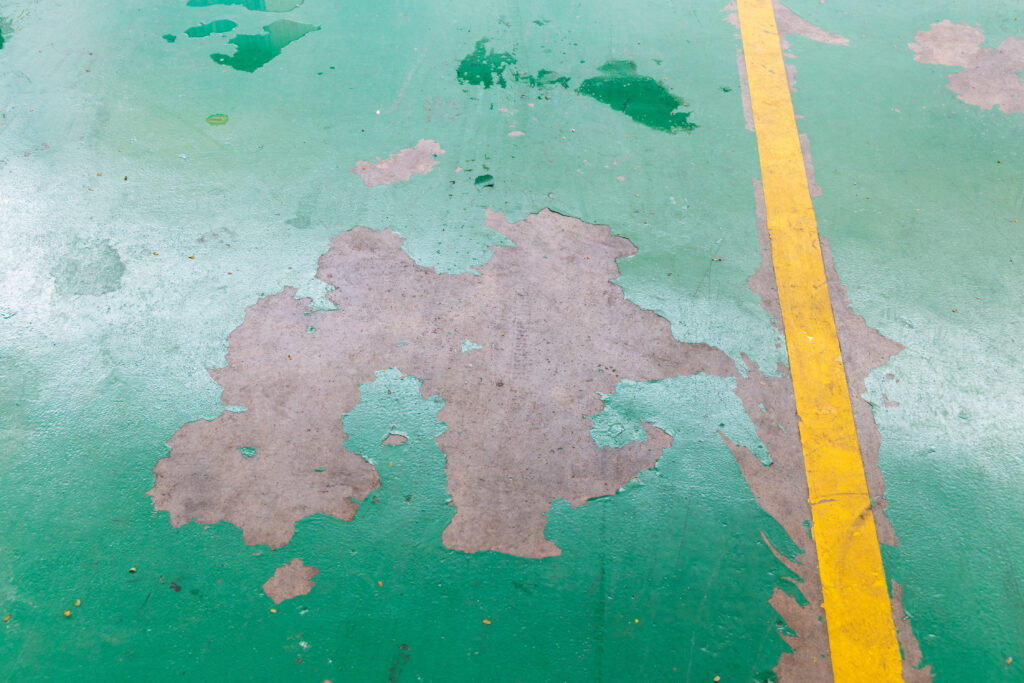
You pull into the garage after a long, hot drive, park like you always do, and back out the next morning. Stuck to your tire tread is a gray strip of your garage floor coating. Underneath it, bare concrete. That is hot tire pickup epoxy failure in its plainest form, and September is exactly when Valley homeowners start noticing it, because the damage from a 115 degree summer has finally had time to show.
Here’s the direct answer up front. Hot tire pickup epoxy damage happens because ordinary bare epoxy softens when a sun-baked tire sits on it, then bonds to the cooling rubber and peels away when the car moves. The coating itself is the weak link. A floor coated with a thin, single-layer epoxy kit will almost always fail this way in the Phoenix area. A professionally installed system that pairs a penetrating epoxy base with a heat-resistant polyurea topcoat will not. That difference is the whole hot tire pickup epoxy story in one sentence.
Armor-Kote Garage Floors installs exactly that kind of two-step system for homeowners across Tempe, Chandler, Mesa, Scottsdale, and the greater Phoenix metro. If your floor is already showing tire marks or peeling, request a free in-home estimate. There’s no deposit and no pressure, just a straight answer on whether you are looking at hot tire pickup epoxy failure or ordinary wear.
What Causes Hot Tire Pickup Epoxy Failure in Phoenix Garages?
Three things gang up on your floor at once, and all three are worse here than almost anywhere else in the country.
First, heat. Pavement in the Phoenix sun gets far hotter than the air, and your tires absorb that heat on the drive home. By the time you park, the rubber can be well over 140 degrees. Ordinary epoxy is a thermoplastic-like material at its surface, which means it softens as it warms. A hot tire pressing down on softened epoxy is essentially a warm iron sitting on plastic.
Second, chemistry. Tire rubber contains plasticizers, the oils that keep tires flexible. When hot rubber sits on epoxy for hours, those plasticizers migrate into the coating and weaken it right where the tread makes contact. That’s why the damage shows up as tire-shaped patches instead of random spots.
Third, the bond. As the tire cools overnight, the rubber contracts and grips the softened coating. When the bond between the epoxy and the concrete is weaker than the grip of the tire, the coating loses. Over smooth, unprepared, or dusty concrete, that bond was weak from day one, and hot tire pickup epoxy failure in that condition is a matter of when, not if.
Why a 115 Degree Summer Pushes Bare Epoxy Past Its Limit
People sometimes assume epoxy failure Arizona heat produces means the product was defective. Usually it wasn’t. It was simply the wrong product for this climate, applied the wrong way, and nearly every hot tire pickup epoxy call we take starts right there.
The DIY kits sold at home improvement stores are typically water-based epoxies applied at a fraction of the thickness of a professional coating. They cure soft, and they’re usually rolled over concrete that was acid etched or, worse, just mopped. Tempe garages also swing from cool winter nights to slab temperatures well above 100 degrees in July and August, and that constant expansion and contraction fatigues a thin coating the way bending a paperclip eventually snaps it. After one full summer, the coating has been softened, contaminated by plasticizers, and flexed hundreds of times. The first set of hot tires starts the peeling, and by September the hot tire pickup epoxy damage is visible from the driveway.
There’s one more culprit behind epoxy failure Arizona heat brings out: moisture vapor. Even in the desert, water vapor pushes up through concrete slabs, and monsoon season raises the pressure. A coating with poor adhesion gets pushed off from below at the same time hot tires pull it from above. Quality systems are tested to withstand that vapor pressure, and the Armor-Kote system is built to hold at a minimum of 8 pounds of moisture vapor emission pressure where many coatings let go at 3. Cheap ones aren’t tested for it at all, which is why hot tire pickup epoxy failure is so often a two-sided problem.
Garage Floor Peeling Phoenix Homeowners Should Catch Early
Peeling rarely starts as a dramatic sheet of coating on your tire. Look for smaller signals during a September walk-through, while summer damage is fresh. Shiny, polished-looking patches where your tires park. Tire marks that won’t wipe off. Small bubbles or blisters, especially after monsoon storms. Hairline flaking at the slab’s expansion joints. Any one of these means the coating has started letting go, and garage floor peeling Phoenix homes develop only moves in one direction once it starts. Catching hot tire pickup epoxy damage at this stage means a straightforward fix instead of living with bare, oil-stained concrete for another year.
Polyaspartic vs Epoxy Heat Performance: What Actually Matters
Shop around for coatings and you’ll run into the polyaspartic vs epoxy heat debate everywhere. Most polyaspartic vs epoxy heat comparisons stop at the resin name, though, and that misses the point. What matters is the system as a whole, and whether that system survives hot tire pickup epoxy conditions through a full July.
Epoxy, as a base coat, has real strengths. It’s thick, it builds well, and the right formulation penetrates deep into properly ground concrete. Its weakness is the surface: left bare, it softens in heat and chalks in UV light, which is where hot tire pickup epoxy trouble almost always begins. Polyaspartics and polyureas are the opposite. They cure fast, stay hard at high temperatures, and hold their clarity in sunlight, which is why they make outstanding topcoats.
That’s the logic behind the Armor-Kote system. We use a proprietary epoxy base that wicks deep into the concrete for a bond roughly three times stronger than typical coatings, then protect it with a high-gloss polyurea topcoat. The topcoat takes the heat, the UV, and the tire contact. The base holds the floor. That pairing is what makes a floor genuinely hot tire pickup epoxy resistant rather than merely shiny, and it’s why ours won’t yellow, darken, or lift, backed by a limited lifetime warranty against peeling and delamination. You can see the full system details on our epoxy garage floor coatings page, and the reasons homeowners choose us come down to the same two layers.
What Fixing a Peeling Garage Floor Involves, and What It Costs
Here’s the part most coating articles skip. You can’t simply roll a new coat over a floor that’s already peeling. The failed material has to come off completely, or the new coating inherits the old bond and the hot tire pickup epoxy failure repeats on schedule.
A proper redo starts with diamond grinding the entire slab to remove the old coating and open the concrete’s pores. Surface preparation standards like ICRI Technical Guideline 310.2R exist precisely because coating performance depends on the profile of the concrete underneath. Grinding is the single biggest difference between a professional installation and a weekend kit. Cracks and stem walls get repaired next, then the base coat, decorative flake, and topcoat go down.
For a standard two-car garage in the Phoenix area, a complete Armor-Kote installation typically runs between $1,500 and $4,000, depending on the condition of your concrete, the size of the space, and the colors and flake blend you choose. Most installations are finished in a single day. You can walk on the floor within hours and park on it after about 24 hours, so you’re not displaced from your garage for a week. There’s no deposit to schedule, and payment isn’t due until the day of installation. More timing and warranty details live on our frequently asked questions page.
Frequently Asked Questions
Ready for a Floor That Shrugs Off August?
Your garage floor shouldn’t be a casualty you count every fall. Armor-Kote Garage Floors coats Valley garages from our Tempe location, and we’ve seen every version of hot tire pickup epoxy failure there is. Browse our gallery of finished floors to see what your space could look like, then reach out for a free estimate. We’ll give you a straight assessment, a firm price, and a floor that’s still holding tight when next summer’s 115 degree streak rolls around.
Contact Us
John Brownlee
John Brownlee is the President of Armor-Kote Garage Floors, a garage floor coating company serving more than forty communities across the greater Phoenix metro from locations in Tempe and Chandler. Armor-Kote focuses on one thing and does it well: epoxy garage floor coatings, installed with a one-day system that keeps downtime to a minimum. Repairs and stem walls are included at no extra charge, and every floor is backed by a lifetime warranty against peeling and delamination. A licensed Arizona contractor (ROC #299892), the company has earned five-star ratings on Google, Yelp, and the BBB from homeowners in Scottsdale, Gilbert, Mesa, Chandler, and beyond. Through the blog, John shares what he and his team of certified installers have learned about coatings, concrete, and keeping Arizona garages looking their best.